
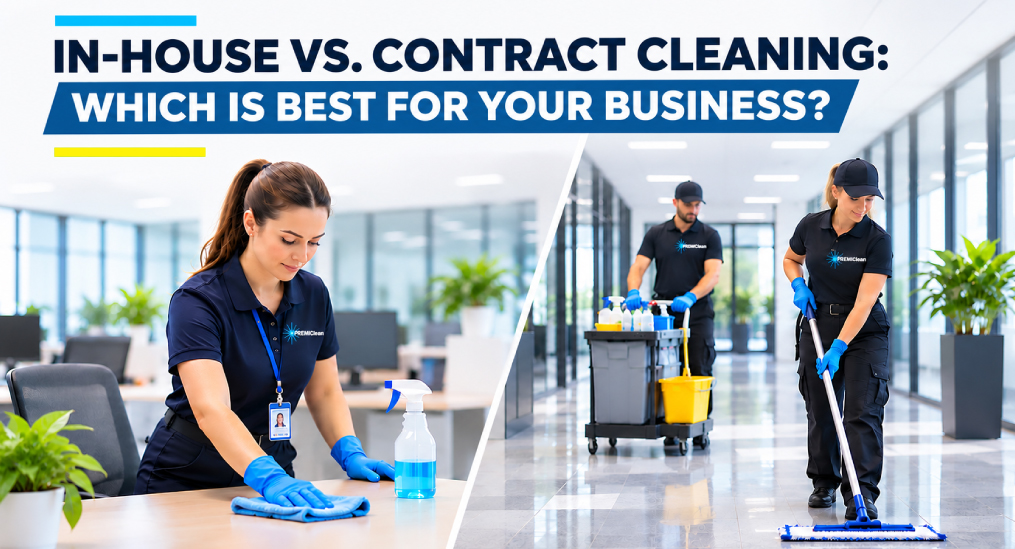
Keeping your workplace clean is important, but how you manage your cleaning can make a big difference to your business.
Should you hire in-house cleaners or book a professional cleaning company? Both options have their benefits, but they also come with different costs, responsibilities, and challenges.
Having an in-house team means you have more control over cleaning schedules and daily tasks, but you must also deal with recruitment, training, equipment and staff absences. Contract cleaning, on the other hand, takes a lot of that responsibility off your plate, so you can concentrate on running your business.
So which option is better for you?
Quick Difference: In-House Vs Contract Cleaning
| Factor | In-House Cleaning | Contract Cleaning |
| Employment | Direct employees | Contractor’s employees |
| Costs | Wages and running costs | Agreed service fee |
| Staff cover | Managed internally | Arranged by contractor, subject to agreement |
| Supervision | Internal management | Contractor supervision, if included |
| Equipment | Purchased internally | Supplied as agreed |
| Flexibility | Direct control | Based on contract terms |
| Compliance | Employer responsibilities | Responsibilities depend on each party’s legal duties |
In-house cleaning might give you more flexibility, but if you outsource office cleaning, you get professional cleaning with less workload.
What In-House Cleaning Includes
In simple words, it means that you hire in-house cleaners enrolled on the company payroll to clean the property.
You are responsible for recruiting the staff, arranging their working hours, providing them with cleaning supplies and products needed, and paying them wages based on their work.
Initially, you may think this sounds cheaper since you’re only paying your employees. However, the cost of the wages is not the only cost of the in-house cleaning service.
When calculating the cost of an in-house cleaning team, remember:
- Wages and employment costs: Salaries, cost of National Insurance contributions, pension contributions, and other employment cost.
- Holiday and sickness cover: Make sure that other employees are on hand or there is a plan in place to redistribute the cleaning tasks when staff is absent.
- Recruitment: It involves advertising for job opportunities, interviewing candidates, conducting background checks, and the onboarding process.
- Training: Cleaners should be appropriately trained in cleaning techniques, the use of cleaning equipment, safe working practices and the storage and use of chemicals.
- Cleaning equipment and supplies: Purchase and use of vacuum equipment, floor machines, cleaning cloths and chemicals, and protective equipment.
- Management time: Managers/Supervisors arrange schedules, supervise, and respond to complaints.
However, it is not as simple as it sounds when it comes to the cost. If the cleaner suddenly leaves, for example, you might need to recruit and train a new cleaner.
Often times, the average office cleaning cost in Warrington is way less than what you spend on managing an in-house cleaning team.
What Contract Cleaning Includes
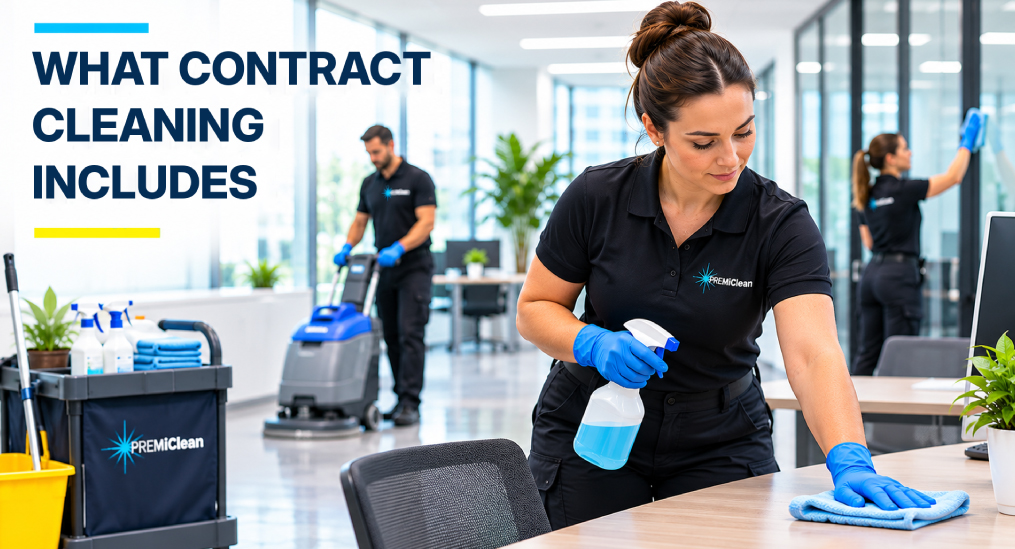
Contract cleaning is a type of clean-up that is performed by an outside cleaning service in accordance with a contract between the two parties. You don’t employ and manage individual cleaners, instead, you sign a contract with a cleaning service for your business cleaning needs.
The cleaning agreement should specify what is to be cleaned, how often, when, and what the cleaning will consist of. It should also mention those that will supply cleaning materials, equipment and consumables.
For instance, if a business is considering contract office cleaning in Warrington, they would need to consider more than just the hourly rate for cleaning. They should also observe the employer’s approach to staffing, the cleaning standards and their response when problems arise.
Pros and Cons of Each Option
In-House Cleaning
The major benefit of building an in-house cleaning team is that you have direct control over their schedule timings, daily tasks, and other duties. Similarly, being in the team, they can communicate their issues directly to internal managers.
However, it also means that you are also responsible for hiring, training, and other employment problems. Those employment problems could be managing absentees, replacing staff when a cleaner leaves, and managing internal conflicts.
So it is safe to say that you should only opt for building an in-house cleaning team when you have adequate resources and sufficient managerial skills to manage the cleaning staff and in-house cleaning costs.
Contract Cleaning
One of the major differences between contract cleaning vs in-house cleaners is that a contractor leaves you with less administrative work. You don’t have to care about recruiting staff, managing their day-to-day tasks, covering for absentees, or carrying out a budget for each employee.
You simply have to sign a contract with your agreed terms and conditions, pay an agreed service fee, and you’re all done.
But that does not mean there are no downsides to hiring a cleaning company.
You must do a good background check on your cleaning company so that you know they match your agreed cleaning protocols. Along with that, you have less direct control over the cleaning staff, and you just have to trust them to keep their promise.
However, you can minimize these disadvantages by simply hiring a professional cleaning company with a reliable management and service standards.
If you are currently considering the cleaning of your premises, you may want to check out our services and how we can help your premises within the cities of Warrington, Manchester, Liverpool and more.
Hidden Risks Businesses Should Consider
1. Absence Cover
Leaving cleaning tasks to an in-house cleaner may result in important cleaning jobs being left behind. This is especially difficult in offices, schools and public buildings which have cleaning to be done during weekdays.
The contract cleaning company should have a definite system in place for absence management. Inquire about the speed in which replacement staff can be provided and if it is part of the agreed compensation.
2. COSHH Training
The Control of Substances Hazardous to Health (COSHH) is a term used to describe substances that pose a risk to health. In the UK the COSHH regulations require the assessment and control of risks from hazardous substances at work.
Cleaning chemicals may irritate skin, lead to breathing problems and cause other health issues if not used properly.
The external cleaning company should have appropriate procedures in place to control chemical safety. However, the entire responsibility for health and safety in the workplace is not removed from the organisation that controls the workplace when the work is outsourced.
3. Inconsistent Standards
If no system of checking the completed work, standards may be lowered.
To avoid this, businesses need to set measurable cleaning requirements. These can be task checklists, scheduled inspections, visits by the supervisor and a system for reporting issues.
Whether cleaners are hired in-house or from a contracting company, regular monitoring is important.
When In-House Makes Sense, and When Contract Cleaning Does
It will depend on the size of your organisation, how often you clean and how well you will manage staff.
When to Opt for In-House Cleaning?
In-house cleaning might be appropriate when:
- You have a large premises, requiring a full-time cleaning team.
- You have very specific or dynamic cleaning needs.
- You have a proven team of facilities management personnel.
- You have the means to hire, coach and manage cleaners.
- Cleaning schedules are high priority for direct control.
When to Opt for Contract Cleaning?
Contract cleaning might be preferable when:
- You want to save time in handling your cleaning staff.
- You need consistent coverage for your business all week long.
- You desire people who are trained and supervised to clean.
- You like a schedule and service plan that is agreed upon.
- You require cleaning services with the ability to evolve with your business.
It can be especially beneficial for offices, educational institutions, and public sector buildings, where maintaining standards is crucial.
Switching to a Contractor: TUPE Basics
An important factor to consider when transitioning from in-house cleaning to an external cleaning company is TUPE.
The acronym TUPE is an acronym for Transfer of Undertakings (Protection of Employment). It is a piece of legislation in the UK to safeguard workers when the workplace or service moves from one employer to another.
This is especially applicable in the case of an organisation outsourcing their cleaning services.
However, not all cleaning arrangements are automatically considered to be TUPE transfers. Certain legal criteria are required, such as if the employee is clearly designated to the service that is being transferred.
Read the UK Government’s TUPE rules when outsourcing a service, including employee protection and service provision changes for detailed guidance.
How to Make the Switch to Contract Cleaning
Transitioning from in-house cleaning to an outside company is more than just picking a contractor and paying for services. A structured approach can help to ensure that there are no gaps in services and that cleaning standards are easier to maintain.
1. Assess the Current Cleaning Needs
First of all, determine what is in need of cleaning, how often it should be cleaned and what tasks your staff is performing to clean it. Think of office size and staff count, washroom facilities, communal areas, and any specialist cleaning needs.
2. Determine What your Current Expenses Are
Calculate the total expense of your existing system (salaries, employment, equipment, cleaning supplies, training and absences). This will make it easier to compare outside quotes.
3. Evaluate Possible Cleaning Companies
Don’t just think of the price, consider the total cost. Ask about:
- Recruiting and training staff.
- Site inspections and Supervisor involvement
- Holiday/sickness cover.
- Arranging cleaning equipment and products.
- Health and safety procedures.
- Complaint handling and performance reviews.
The provider should be able to give a clear account of how it works to maintain standards and how it resolves issues
4. Arrange a Site Assessment
To make a successful cleaning schedule, a cleaning company should first know your premises. The site visit serves to pinpoint cleaning priorities, access needs and areas that require specialist cleaning attention.
Through a free site survey, PREMiClean will help you to evaluate your premises and understand the cleaning needs.
5. Set the Levels of Service Agreed Upon
Discuss and verify the work to be done, hours, frequency and standards before signing an agreement.
Discuss and agree upon inspection arrangements, reporting, cover for the absence of children and how changes to the service are managed.
6. Transition Planning should be Carefully Planned
Where TUPE might apply, seek employment advice to ensure a clear transfer process before the transfer of services.
Inform appropriate staff and other parties of the arrangements to be made. Ensure that access, equipment, cleaning supplies and responsibilities are in place prior to the contractor’s arrival.
7. Once a Service Starts, Monitor It
After the contract has begun, check the cleanliness requirements on a frequent basis. Schedule feedback sessions, review and discuss completed assignments promptly.
Any contractor worth their salt should be open to input and know how to improve.
Summing Up: In-House Versus Contract Cleaning
The decision between in-house cleaning vs. contract cleaning depends on the cost, control and resources a company has to handle cleaning.
The in-house cleaning service provides immediate control, but also carries the added burden of recruitment, training, equipment and staff coverage and supervision. Businesses can offload the agreed cleaning requirements to a contract cleaning provider, focusing on business operations.
PREMiClean brings more than 20 years of industry experience and hands-on management, with well-trained and closely supervised cleaning staff. Our directly employed team is also part of our approach, as well as our digital systems to ensure our services are provided in a consistent manner.
Contact PREMiClean and speak about your business’s cleaning needs and discover a cleaning solution that is suitable for your business.
Frequently Asked Questions
Is in-house cleaning cheaper than contract cleaning?
Not always. In-house cleaning includes wages, training, equipment, staff cover and management costs, while contract cleaning has an agreed service fee.
What are the main benefits of contract office cleaning?
Contract cleaning reduces your management workload, provides trained cleaners and helps arrange staff cover, allowing you to focus on running your business.
When should a business choose in-house cleaning?
In-house cleaning may suit businesses with large premises, specific cleaning needs and enough resources to recruit, train and manage their own cleaning team.
Does TUPE apply when switching to contract cleaning?
TUPE may apply when cleaning services are outsourced, protecting eligible employees during the transfer. Whether it applies depends on specific legal criteria.
What should I look for when choosing a contract cleaning company?
Look for trained staff, reliable absence cover, clear cleaning schedules, health and safety procedures, regular inspections, and good communication.